Learning Mixed Strategies in Trajectory Games

@inproceedings{peters2022rss,
    title     = {Learning Mixed Strategies in Trajectory Games},
    author    = {Peters, Lasse and Fridovich-Keil, David and Ferranti, Laura and Stachniss, Cyrill and Alonso-Mora, Javier and Laine, Forrest},
    booktitle = {Proc.~of Robotics: Science and Systems (RSS)},
    year      = {2022},
    url       = {https://arxiv.org/abs/2205.00291}
}
Abstract
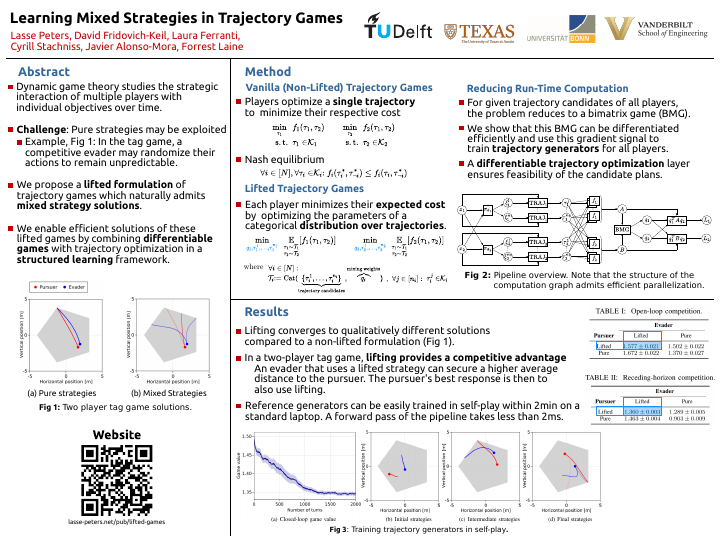
In multi-agent settings, game theory is a natural framework for describing the strategic interactions of agents whose objectives depend upon one another’s behavior. Trajectory games capture these complex effects by design. In competitive settings, this makes them a more faithful interaction model than traditional “predict then plan” approaches. However, current game-theoretic planning methods have important limitations. In this work, we propose two main contributions. First, we introduce an offline training phase which reduces the online computational burden of solving trajectory games. Second, we formulate a lifted game which allows players to optimize multiple candidate trajectories in unison and thereby construct more competitive “mixed” strategies. We validate our approach on a number of experiments using the pursuit-evasion game “tag.”
Code
This project has produced a range of software packages, all of which are publicly available at on GitHub at the links below:
- LiftedTrajectoryGames.jl: The reference implementation of the lifted trajectory games solver.
- DifferentiableTrajectoryOptimization.jl: Differentiable trajectory optimization in Julia.
- TensorGames.jl: Computing mixed-strategy Nash Equilibria for games involving multiple players.
- TrajectoryGamesBase.jl: Core interface to design, solve, and simulate trajectory games.
- TrajectoryGamesExamples.jl: Example environments and tools for the TrajectoryGamesBase interface.
Supplementary Material
Talk
Supplementary Video
Poster
Last Updated: 2022-07-14